Times Square
The Sun is Also a StarTimes Square is a location of interruption and redirection: a stalled train deposits its passengers there, and the narrator’s response to the station’s disorder leads into a street-level search for meaning. The place first appears not as a destination chosen freely but as the abrupt end of a journey. It then becomes the setting against which the narrator tests whether an apparently random encounter might count as a sign.
The subway interruption
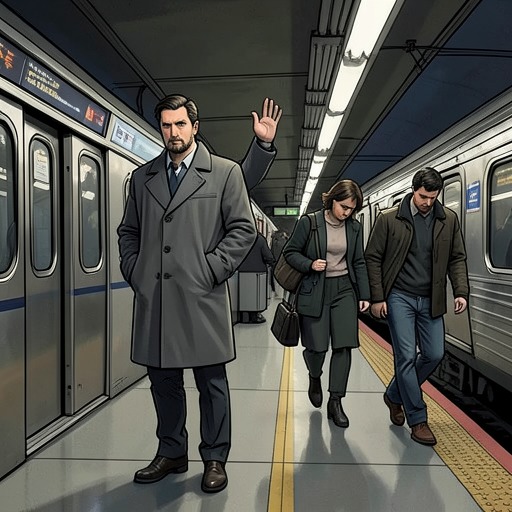
The approach to Times Square follows a prolonged stop in darkness. After an evangelizing conductor falls silent, the train moves again, reaches the station, and keeps its doors closed while the passengers wait. The loudspeakers then announce that the train is out of service and direct everyone to leave. This sequence makes the station a threshold imposed by circumstance: the passengers have arrived, but not through the ordinary completion of their trip.
The announcement extends the conductor’s earlier religious appeal, pairing the practical instruction to get off the train with a suggestion that passengers look for God. The crowd does not respond as a congregation. Everyone gets out somewhere between relief and anger, and the narrator observes that each person has somewhere else to be. Times Square therefore gathers two incompatible kinds of urgency in one scene: the conductor’s conviction that life has spiritual purpose, and the passengers’ immediate need to resume their interrupted plans. The gap between those impulses gives the station its first narrative charge.
A commercial landscape and a search for a sign
Once outside, the narrator does not wait for another train to continue toward Thirty-Fourth Street. The decision is linked to a willingness, on what the narrator calls the Final Day of Childhood, to let the universe dictate what happens next. Yet Times Square is not imagined as a quiet place of revelation. Its neon signs advertise the seven deadly sins, and the narrator dismisses it as a kind of hell where God would not be found. The spiritual question raised on the train is carried into the street, but the spectacle of the setting initially seems to work against an answer.
From Times Square the narrator walks down Seventh Avenue toward a barber and watches for a sign. A church on Thirty-Seventh Street briefly offers a possible destination, but its door is locked; the narrator finds no confirming spectacle and continues looking. That failed visit matters to the route through the city: expectation does not resolve into an encounter at the church, and the search remains open as attention shifts back to the street. Times Square is thus the starting point for a movement away from the subway’s fixed route and toward an uncertain interpretation of ordinary details.
The route beyond the station
Across from the church, the narrator notices a girl swaying with her eyes closed, one hand over her heart, and large pink headphones covering her ears. After a few seconds she opens her eyes, hunches her shoulders in apparent embarrassment, and hurries away. The narrator wonders what she is listening to, comparing the intensity of her absorption with the feeling poetry can produce. The encounter gives the search a human focus, though at first it remains only a brief sighting on the sidewalk.
As the girl walks away, she shifts her backpack to one shoulder, revealing the words DEUS EX MACHINA on the back of her leather jacket. The narrator connects the phrase—God from the machine—to the conductor’s religious appeal and wonders whether it is a sign. The next destination is Second Coming Records, which the girl enters. The narrator treats the name as further confirmation and follows at a deliberate half-block distance. These later street encounters occur along the narrator’s route after leaving Times Square; they are not events inside the station. Their significance is that the station’s disruption has already prompted a change of direction, leaving the narrator receptive to interpreting the city as a sequence of clues.
Narrative significance
The setting links a mechanical breakdown to a question about purpose without deciding whether the answer is divine or coincidental. The out-of-service train forces passengers out; the conductor’s announcement gives that inconvenience a religious frame; and the narrator, already hoping for a miracle after a phone call, chooses not to resume the planned trip immediately. From there, an empty search for a sign becomes a chain of concrete observations: a locked church, a girl absorbed in music, words on a jacket, and the name of a record store.
The contrast between Times Square’s commercial neon and the narrator’s search for spiritual meaning keeps the scene open to competing readings. The narrator can regard the city’s details as coincidence, or follow the pattern that the conductor’s words and the jacket’s Latin phrase seem to form. Times Square does not supply a definitive revelation. Its decisive role is to interrupt the expected journey and create the conditions for the narrator to pursue an unplanned encounter, turning a station exit into the beginning of a consequential day.